
Welcome
Welcome aboard the Internet Access Overview section at Check Point SASE's Help Center!
This guide offers a sneak peek into this category and the must-visit resources.
Internet Access - What's Inside?
The Secure Internet Overview category secures your online activities via Check Point SASE.
With comprehensive and easy-to-follow guides, we help you understand the features and settings to bolster your internet security.
Malware Protection
The Secure Web Gateway feature includes a Malware protection engine that intercepts malicious traffic on a user device and protects your users from malware coming through the web.
The tool can scan files of all types, such as:
- HTML
- DOCX
- EXE
- RAR
- ZIP
- JS
- Fonts
- Pieces of malicious code injected into existing files
- Many others
Suppose malicious content is detected during a scan. In that case, the Secure Web Gateway will block it and present the user with a notification detailing the type of malicious content that was detected and blocked: 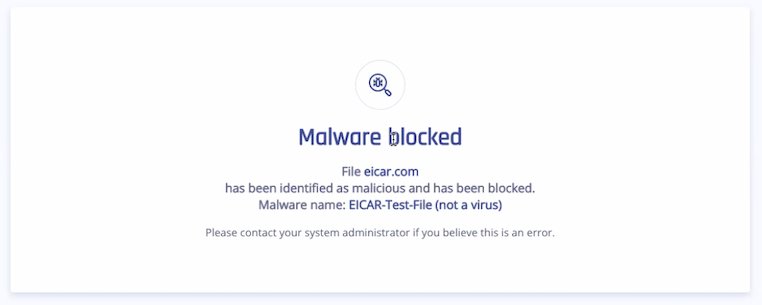
- The Malware detection engine scans the file and blocks access until the software decides if it’s clear or malicious.
- The Malware detection engine scans traffic on the endpoint itself, not affecting your Gateway's performance.
- The Malware detection engine activates automatically for any user with the Access Policy feature activated.
Unified Internet Access Policy with Check Point Firewall
If your organization uses Check Point Firewall Security Gateways, you can manage Internet Access policy from SmartConsole.
This setup uses one Access Control policy and one HTTPS Inspection policy for on‑premises users and remote users.
This setup removes the need to maintain separate policies across platforms.
For setup instructions and details, see:
- Unified Access Policy for SASE and Network Security
- Unified Internet Access Policy for Check Point SASE and Quantum Management Server
Internet Access Speed
Check Point SASE’s hybrid Secure Web Gateway (SWG) architecture enhances internet performance, delivering speeds up to 10 times faster than competing solutions, as validated by independent Miercom benchmarking tests.
This architecture optimizes bandwidth allocation to support enterprise workloads, including latency-sensitive applications such as videoconferencing and real-time collaboration tools.
Factors Affecting Remote User Internet Speed
When evaluating remote user internet performance, consider these variables:
- Internet Service Provider (ISP) performance – Latency, jitter, and bandwidth availability impact connection quality.
- Security policy enforcement – Advanced threat prevention, data loss prevention (DLP), and traffic inspection can introduce processing overhead.
- Network congestion – The number of concurrent users and bandwidth-intensive applications (e.g., streaming, gaming, or cloud workloads) influence available throughput.
Check Point continuously enhances Check Point SASE by investing in network optimization, intelligent traffic routing, and adaptive security measures to deliver an optimal user experience.
Must-Visit Resources
- For information on setting up the Check Point SASE's secure internet gateway, see Manage Secure Web Gateway.
- For information on when and how to configure certificate pinning, see Certificate Pinning.
- For troubleshooting common issues related to secure internet access, see Troubleshooting Guide.
Jumpstart Your Journey
If you're stepping into the world of Check Point SASE, our Getting Started Guide is the perfect starting point.
Support at Your Fingertips
Got questions or need help? Our support team is available round the clock. You can chat with us anytime on our website or drop us an email at sase-support@checkpoint.com